AI Agents for SMEs: What They Are and What They Deliver
AI agents automate decisions inside business processes. Learn how SMEs with 5 to 50 staff deploy them, what they cost, and what measurable results they produce.
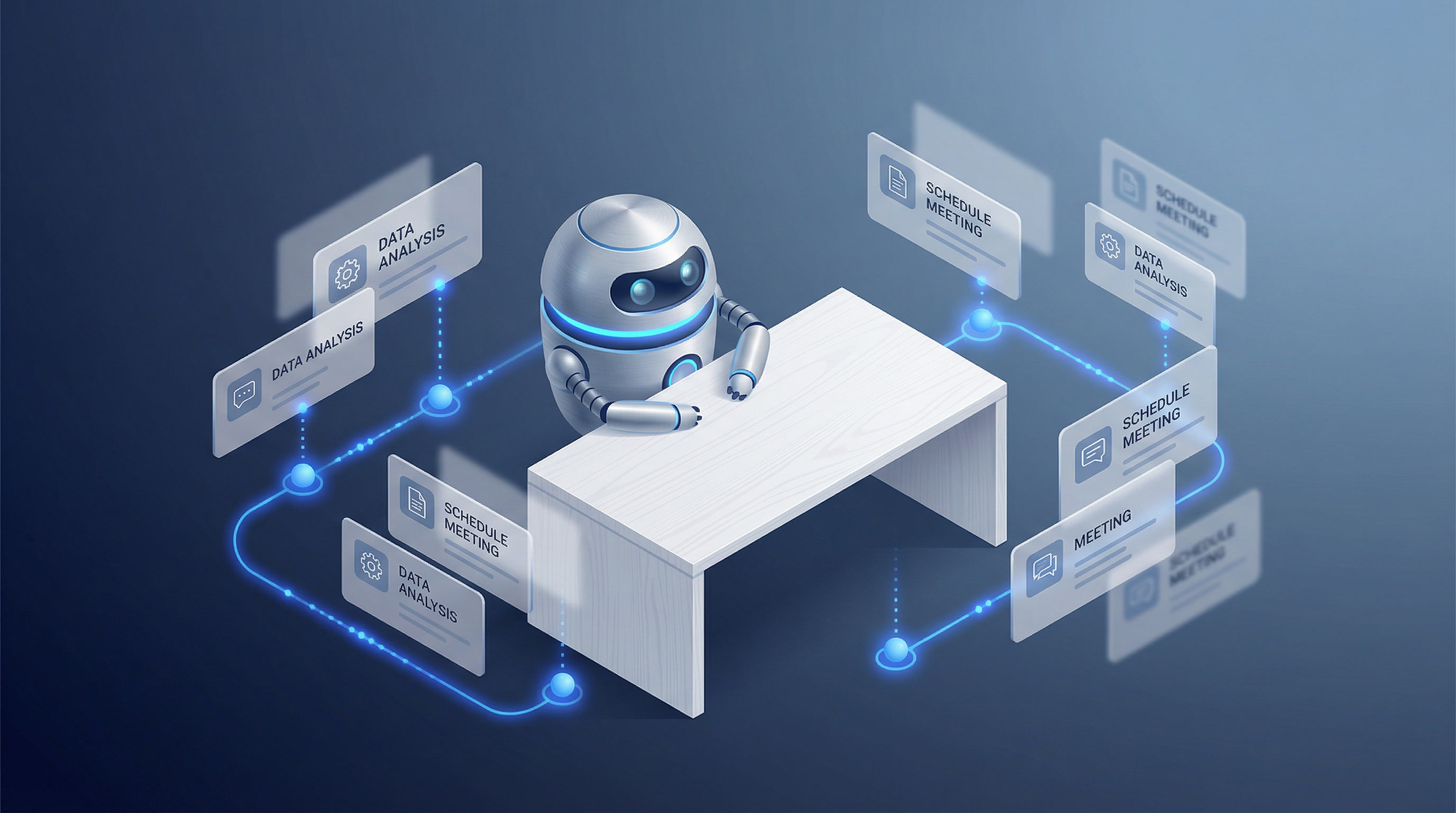
What are AI agents and how do they differ from standard automation?
An AI agent is a software system that makes autonomous decisions based on context, rules, and real-time data, without requiring human confirmation at every step. This distinguishes AI agents fundamentally from traditional automation, where a fixed sequence of steps is executed regardless of the specific situation.
Standard workflow automation, as built in tools such as n8n or Make, follows predetermined logic: if X occurs, execute Y. An AI agent goes further by evaluating the current situation, selecting an approach from multiple options, executing an action, and learning from the result. This makes AI agents suitable for processes involving variation, exceptions, and contextual nuance.
In practice, AI agents are deployed for tasks such as answering customer queries using a knowledge base, qualifying inbound leads against multiple criteria simultaneously, or processing purchase orders where exceptions are automatically flagged for human review. (Source: McKinsey, 2024)
How do AI agents work inside an SME environment?
An AI agent operates on four components: a language model or decision model at its core, a set of available tools or actions, a memory mechanism for context, and an orchestration layer that governs the logic. In an SME context, these components are configured via platforms such as n8n, LangChain, or Make, connected to existing business systems.
Implementation follows a recognisable pattern. First, the target process is analysed to identify where decisions are currently made manually. Next, the agent is configured with the appropriate knowledge sources, such as a product catalogue, CRM data, or internal documentation. The agent is then tested against representative scenarios before going live.
A wholesale distributor can deploy an AI agent that reads incoming customer emails, determines the intent (complaint, order, information request), selects the appropriate response template, retrieves relevant order information from the ERP system, and sends a draft reply to a staff member for approval. This reduces average processing time per email from 8 minutes to under 90 seconds. (Source: Gartner, 2023)
What does an AI agent cost for an SME?
The cost of an AI agent for SMEs varies depending on complexity, integrations, and the chosen platform. A basic implementation via n8n or Make using a language model such as GPT-4o typically costs between 2,500 and 6,000 euros for design and build, plus monthly operational costs of 50 to 300 euros for API usage and hosting.
More complex agents with multiple integrations, cross-session memory, and escalation logic to staff members fall in a range of 6,000 to 15,000 euros for the initial implementation. Platform costs for n8n self-hosted start at approximately 20 euros per month. Cloud-based Make workflows use consumption-based pricing starting from 9 euros per month.
Recurring costs consist of API fees for the language model (averaging 0.01 to 0.06 euros per 1,000 tokens for GPT-4o), platform licences, and any maintenance work. For an SME processing 500 customer interactions per month, total operational costs for an AI agent typically remain below 150 euros per month. (Source: OpenAI Pricing, 2024)
What does an AI agent deliver: ROI calculation for SMEs
The financial return of an AI agent is measurable through three channels: time savings on repetitive tasks, reduction of processing errors, and faster response times that improve customer retention. For an SME with 10 to 30 FTE, annual savings are substantial.
The table below shows a realistic ROI calculation for a professional services firm with 20 FTE deploying an AI agent for customer query processing and lead qualification.
| Parameter | Value |
|---|---|
| Hours saved per week (2 staff members) | 12 hours |
| Average internal hourly rate | 35 euros |
| Annual time saving in euros | 21,840 euros |
| Implementation cost (one-off) | 5,500 euros |
| Annual operational costs | 1,200 euros |
| Net saving year 1 | 15,140 euros |
| Payback period | 4 months |
| ROI after 12 months | 175% |
Beyond direct cost savings, SMEs deploying AI agents report an average improvement in customer satisfaction scores of 18 per cent, driven by faster response times and more consistent answers. (Source: Salesforce State of Service, 2024)
Which tools are suitable for AI agent implementation in SMEs?
The choice of platform determines the flexibility, cost, and technical threshold of an AI agent implementation. The two most relevant options for Dutch SMEs are n8n and Make, supplemented by LangChain for more complex use cases.
| Criteria | n8n | Make | Recommendation |
|---|---|---|---|
| Platform type | Open-source, self-hosted or cloud | Cloud-based SaaS | n8n for data privacy and customisation |
| AI agent support | Built-in AI nodes, LangChain integration | Limited native AI support | n8n for advanced agents |
| Platform start cost | Free (self-hosted) to 20 euros/month | 9 euros/month | Make for a quick start |
| Technical threshold | Moderate (JSON knowledge required) | Low (visual interface) | Make for non-technical users |
| Scalability | High | Moderate | n8n for growing automation |
| GDPR control | Full (own server) | Dependent on Make infrastructure | n8n for sensitive business data |
For SMEs in professional services or manufacturing that handle customer data, n8n is the recommended choice due to full control over data storage and extensive AI agent configuration capabilities. Make is appropriate as a starting point for businesses that want to test a simple agent quickly without setting up technical infrastructure.
Practical case study: AI agent at a Dutch wholesale distributor
A wholesale distributor of technical components with 28 FTE processed an average of 140 inbound customer queries per day via email. This required three staff members a combined total of approximately 22 hours per day. Queries ranged from stock availability and delivery times to technical product specifications and return procedures.
Vynexo implemented an AI agent via n8n, connected to the existing ERP system and a knowledge base containing product documentation. The agent reads incoming emails, classifies the query type, retrieves relevant data from the ERP, generates a draft response in the company's house style, and forwards it to the responsible team member for quick approval via an internal Slack message.
Following implementation, average handling time per customer query dropped from 9.5 minutes to 2.1 minutes. The team saved 14 hours per week, amounting to an annual cost saving of 25,480 euros at an internal rate of 35 euros per hour. Implementation costs were 7,200 euros. The payback period was 3.4 months.
How to implement an AI agent in 6 steps
A structured implementation significantly increases the likelihood of deploying a working, scalable AI agent. The steps below are based on Vynexo's delivery approach for SME implementations in professional services and wholesale distribution.
- Process analysis and use case selection (week 1): Identify the process with the highest manual workload and the greatest degree of repetition. Document the decision rules that staff currently apply manually. This forms the foundation for agent configuration.
- Data sources and integrations (weeks 1 to 2): Inventory which systems the agent requires: CRM, ERP, knowledge base, email platform. Verify API availability and configure the connection via n8n or Make. Expected outcome: a working data connection without manual data export.
- Agent configuration and prompt design (weeks 2 to 3): Write the system instructions for the language model. Define which tools the agent may use and under what conditions it escalates to a human. Expected outcome: an agent that responds correctly on test scenarios in more than 85 per cent of cases.
- Internal testing with historical data (week 3): Run a minimum of 50 historical cases through the agent. Compare agent output with actual handling by staff members. Identify and correct deviations in the decision logic. Expected outcome: error rate below 10 per cent on representative cases.
- Phased go-live with human oversight (week 4): Begin with a parallel run where the agent generates output but a staff member always approves. Build confidence in the agent before enabling fully autonomous processing. Expected outcome: acceptance rate above 80 per cent of agent output without modification.
- Monitoring, optimisation, and scaling (month 2 onwards): Set up dashboards to track processing volume, error notifications, and escalation frequency. Refine the agent monthly based on new exceptions encountered. Expand the agent to adjacent processes once performance is stable.
Frequently asked questions about AI agents for SMEs
Does my business need technical expertise to implement an AI agent?
A basic implementation via Make requires no technical expertise and is accessible to non-technical users. For more advanced agents via n8n, knowledge of JSON and API connections is helpful but not strictly necessary when working with an implementation partner. Most SMEs have the initial configuration handled by a specialist and then manage the agent independently thereafter.
Is an AI agent safe for sensitive customer and business data?
Data security depends on the architectural choice made during implementation. With a self-hosted n8n installation, all data remains on your own server and no information is shared with external parties, with the exception of API calls to the language model. For maximum control, you can opt for a locally hosted language model or a European cloud-based API. Never process personal data through an AI agent without a data processing agreement with the API provider in compliance with GDPR.
What is the difference between an AI agent and a chatbot?
A chatbot follows a pre-written conversation script and can only respond to anticipated inputs. An AI agent possesses reasoning capabilities, can execute actions in external systems, handles unexpected situations, and adapts its approach based on context. A chatbot answers a question about delivery time; an AI agent retrieves the current delivery time from the ERP system and automatically confirms the order if conditions are met.
Which processes are most suitable for an AI agent in an SME?
The processes with the highest ROI for AI agents in SMEs are customer query processing via email, lead qualification based on multiple criteria, invoice verification and matching processes, and internal knowledge retrieval by staff members. Processes are most suitable when they occur at high frequency, follow a defined set of decision rules, and are currently handled manually by staff whose cost exceeds that of the automation solution itself.