Deploying AI Agents for Process Automation: A Practical Guide for SMEs
AI agents automate complex business processes without constant human intervention. This guide explains what AI agents are, how they operate within SME environments, what implementation costs look like, and what return on investment businesses can realistically expect.
What Are AI Agents and Why Do They Matter for SMEs?
An AI agent is a software component that independently executes tasks, makes decisions based on available data, and takes actions to reach a predefined goal. Unlike traditional automation scripts that follow fixed step-by-step instructions, AI agents can respond to changing circumstances, interpret context, and coordinate multiple systems without direct human oversight.
For small and medium-sized enterprises, this distinction has significant practical implications. Many SMEs lack the staffing capacity to manage repetitive administrative tasks manually at scale. AI agents provide a scalable solution where processes such as invoice handling, customer inquiries, inventory management, and reporting are executed automatically, including outside business hours.
The technology has become substantially more accessible over the past three years. Platforms such as n8n, Make, and Zapier offer visual interfaces that allow AI agents to be configured without extensive programming knowledge. This lowers the entry barrier for SMEs looking to invest in structured automation.
What Does an AI Agent Implementation Cost for an SME?
The cost of an AI agent implementation depends on process complexity, the chosen platform, and the degree of customisation required. A simple AI agent that classifies and forwards emails costs significantly less than one that combines order processing, customer segmentation, and invoicing.
The table below provides an indicative cost overview for three common implementation scenarios within SME environments.
| Scenario | Description | One-Time Implementation Cost | Monthly Operational Cost |
|---|---|---|---|
| Basic | Email sorting and simple task delegation via n8n | 500 to 1,500 euros | 30 to 80 euros |
| Intermediate | Customer support agent with CRM integration | 2,000 to 5,000 euros | 100 to 250 euros |
| Advanced | Fully automated order processing across multiple systems | 6,000 to 15,000 euros | 300 to 700 euros |
These figures exclude internal management time and potential costs for API usage from language model providers such as OpenAI or Anthropic. For most SME implementations, total annual costs including maintenance range between 3,000 and 20,000 euros, depending on the scale and complexity of the automated processes.
How Does an AI Agent Work in Practice?
An AI agent operates through a cycle of perceiving, reasoning, and acting. The agent receives input from an external source, such as an incoming email, a form submission, or a database update. It then processes this input through a language model or decision system and determines which action to take. Finally, the agent executes the action through a connected system, such as a CRM, ERP, or communication platform.
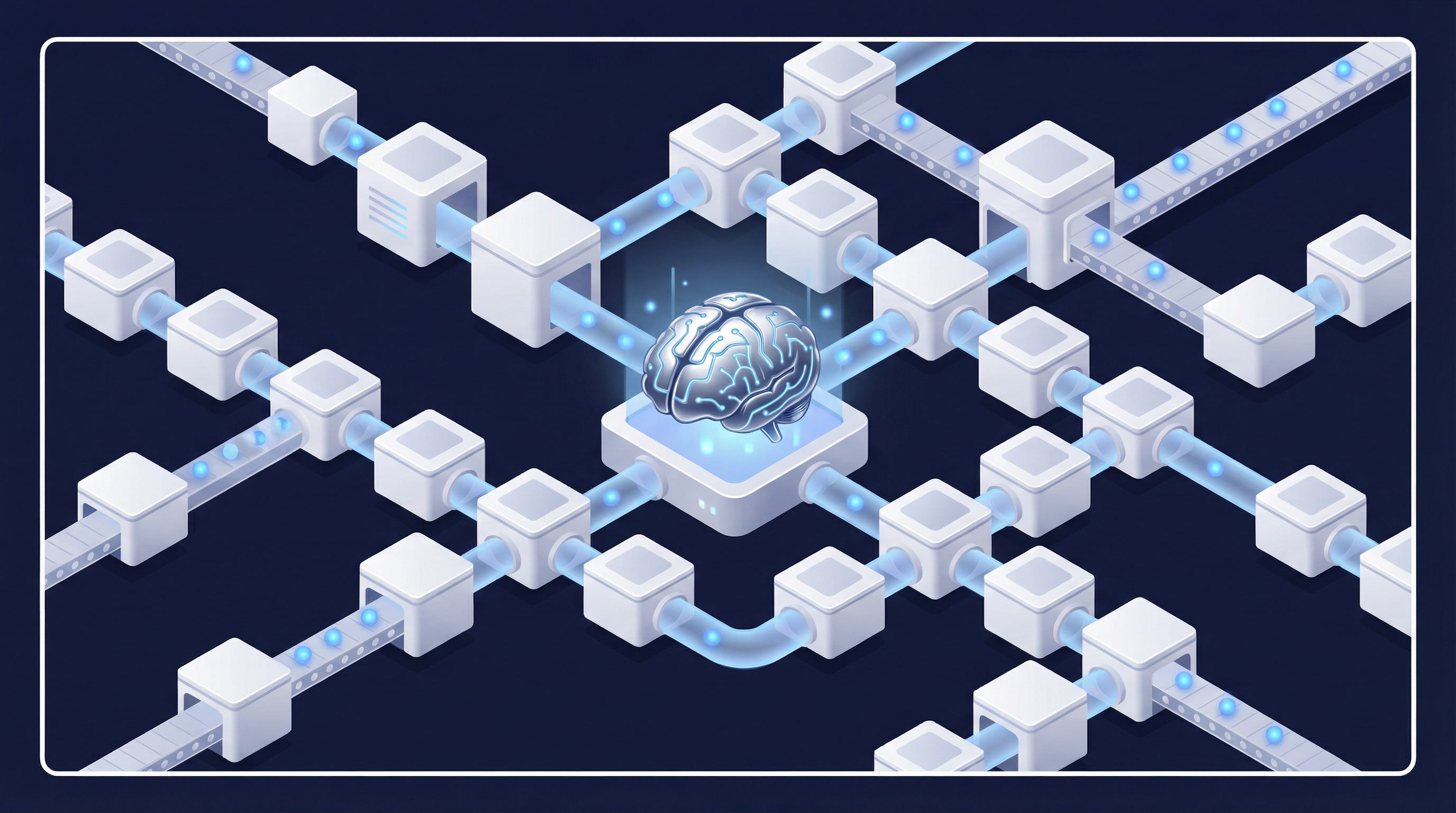
In an n8n environment, this process is constructed visually through linked nodes. Each node represents a step in the workflow: retrieving data, calling an AI model, processing the response, and triggering a follow-up action. This makes the process transparent and adjustable without requiring any code to be written.
A key characteristic of well-configured AI agents is the use of memory mechanisms. An agent with memory can retain earlier interactions and adjust its behaviour based on context from previous sessions. This is particularly relevant for customer service agents that need to provide consistent responses to returning clients.
ROI Calculation: A Practical Example
A distribution company with 25 employees processes an average of 150 incoming orders per day. Previously, two administrative staff members were fully occupied with entering orders into the ERP system, sending order confirmations, and updating inventory status. The combined employment costs for these two employees amounted to 72,000 euros per year including social contributions.
After implementing an AI agent on the n8n platform, these three tasks were fully automated. Implementation costs were 8,500 euros as a one-time investment. Annual operational costs for the platform and API usage amount to 2,400 euros. The two employees were reassigned to customer-facing roles with higher added value.
The net annual benefit breaks down as follows:
- Released staff capacity valued at 72,000 euros per year
- One-time implementation cost of 8,500 euros
- Annual operational costs of 2,400 euros
- Payback period: less than 2 months
- Net ROI in year 1: over 600 percent
This example illustrates that even a relatively contained implementation can generate significant financial returns, provided the automated tasks involve sufficient volume and repetition.
Practical Case Example: Customer Service Automation at a Logistics SME
A logistics service provider with 40 employees received an average of 90 customer inquiries per day via email and a contact form. The inquiries primarily concerned shipment status, return procedures, and invoice questions. One employee spent three to four hours daily responding to these messages.
After implementing an AI agent via n8n, connected to the track-and-trace system and the invoicing platform, incoming inquiries are automatically categorised. Shipment status questions receive an immediate automated response containing current tracking information. Return inquiries trigger a standardised procedure with automatic form delivery. Invoice questions are forwarded to the finance department along with a summary of the relevant invoice data.
Results after three months: 78 percent of all customer inquiries are handled fully automatically without human intervention. The remaining 22 percent involve complex situations that the agent recognises and escalates to the appropriate team member, including a context summary. Average response time dropped from 4.2 hours to 6 minutes.
Step-by-Step Implementation of an AI Agent via n8n
Implementing an AI agent requires a structured approach to avoid errors, unexpected behaviour, and inefficiencies. The steps below describe a proven implementation process for SMEs beginning with AI agent automation.
Step 1: Process Inventory and Selection
Map all repetitive processes that are candidates for automation. Evaluate each process based on volume, repeatability, data accessibility, and current time investment. Select the process with the highest volume and the lowest rate of exception cases as the starting point.
Step 2: Data Structure and System Access
Identify which systems the AI agent needs to query or control. Ensure API access is available for relevant systems such as the CRM, ERP, email platform, or order management system. Document the data structure of incoming and outgoing messages.
Step 3: Workflow Construction in n8n
Build the base workflow in n8n using the visual editor. Start with a trigger node that activates the agent based on an incoming event. Add nodes for data collection, AI processing via a language model, and action execution. Test each node individually before activating the full workflow.
Step 4: Prompt Design and Context Injection
Write a structured system prompt that instructs the AI agent on its role, constraints, and expected output format. Add dynamic context variables so the agent can incorporate relevant data from earlier steps in its reasoning. Test the prompt with representative input examples.
Step 5: Escalation Logic and Error Handling
Define clear escalation criteria. When the agent cannot process a request with sufficient confidence, the workflow should automatically escalate to a human team member with a full context handover. Add error handling nodes that log and report failed actions.
Step 6: Monitoring and Optimisation
Enable logging on all critical workflow steps. Evaluate automation rate, escalation volume, and processing time on a weekly basis. Adjust the prompt, confidence thresholds, or workflow logic based on observed patterns. Schedule a formal review at 30 and 90 days after go-live.
Common Mistakes in SME AI Agent Implementations
A frequent error is automating processes that lack sufficient volume or repetition. Processes that occur only a few times per week rarely generate enough ROI to justify implementation costs. Careful pre-selection based on volume and time investment is essential.
A second common mistake is the absence of a clear escalation route. AI agents make errors, particularly with unusual or ambiguous input. Without a defined escalation procedure, mistakes can go unnoticed and cause operational damage. Every implementation must include a reliable fallback mechanism.
Finally, many SMEs underestimate the importance of prompt maintenance. Language models and business processes change over time. A prompt that performs optimally at implementation may become less effective after several months due to changes in business context or updates to the underlying model. Structured maintenance of prompts and workflow logic is an underestimated but critical component of successful AI agent management.
Conclusion: Structural Value of AI Agents for SME Automation
AI agents represent a significant step forward compared to traditional rule-based automation. They are capable of processing unstructured input, understanding context, and acting dynamically within complex business processes. For SMEs, they offer a scalable alternative to manual task execution without the need for large IT departments.
The implementation threshold has dropped considerably in recent years through platforms such as n8n, which combine visual workflow construction with powerful AI integrations. For well-selected processes, the payback period averages two to six months, with a net ROI that frequently exceeds 300 percent in the first year.
A successful implementation requires a structured approach, realistic process assessment, and consistent maintenance of automated workflows. Businesses that maintain this discipline build a durable operational advantage that scales with organisational growth.